

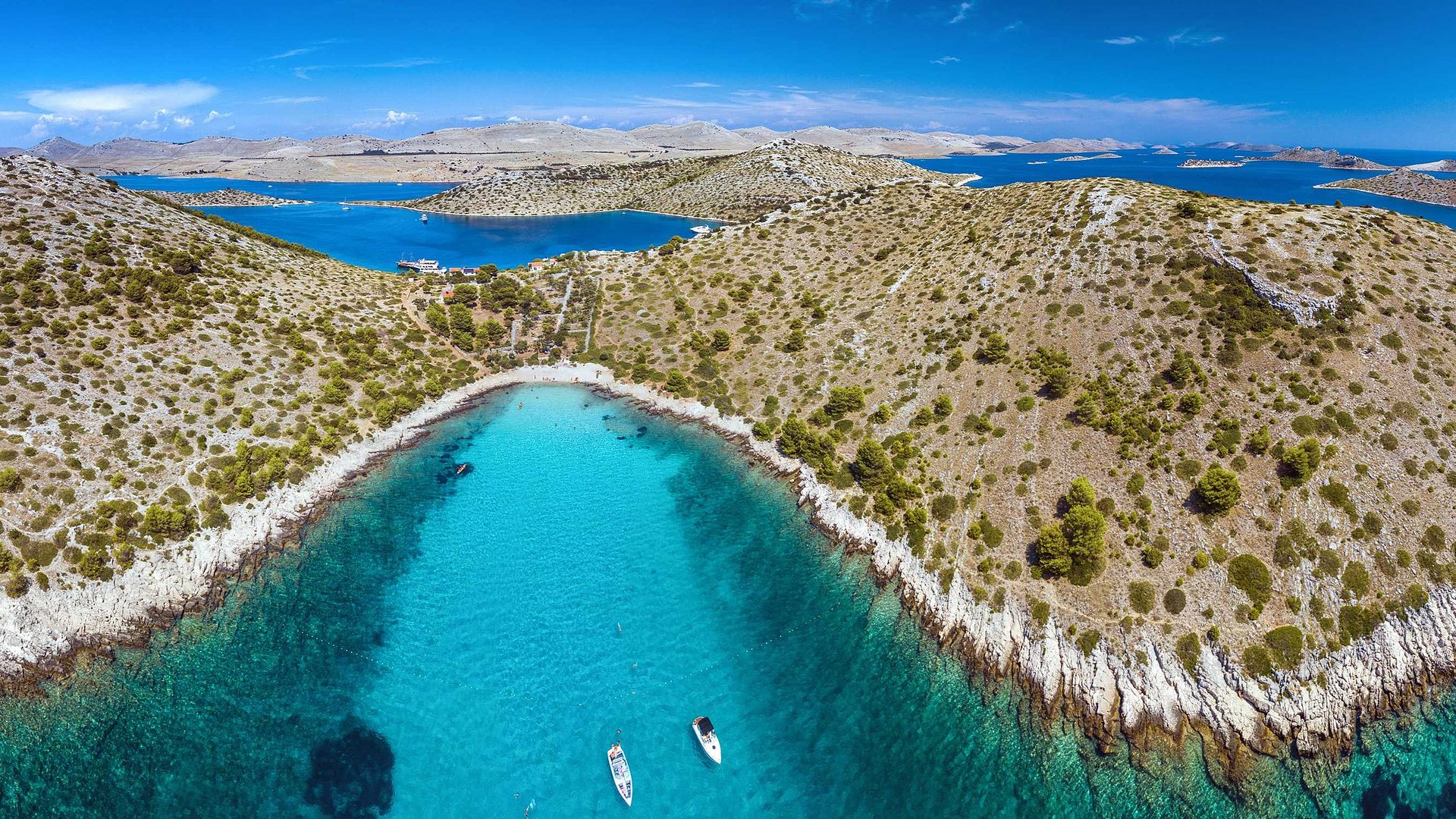
Kornati National Park
Kornati National Park — The Pearl of the Adriatic
Seven nautical miles from Murter and fifteen nautical miles from Šibenik and Zadar lies a place that enchants with its natural beauty, untouched by human hands.
The Kornati Islands, set in the southern part of the North Dalmatian islands, seven nautical miles from Murter and fifteen nautical miles from Šibenik and Zadar, are a place that captivates with a natural beauty untouched by human hands.
This magical place stands out for its exceptional natural splendour, crystal-clear sea, fascinating geomorphology, a “ragged” coastline and a unique marine ecosystem.
The Most “Ragged” Archipelago in the Mediterranean
This is a large group of islands, islets and reefs near the islands of Dugi Otok and Žut. Together they form the most “ragged” archipelago in the Mediterranean Sea. The islands look like pearls scattered across the surface of the sea.
The National Park, as this place was declared in 1980, covers an area of 220 km² and encompasses 89 of the 150 islands, islets and reefs. The land on the mainland side makes up barely a quarter of the total area; the greatest part is the sea itself.
In the immediate vicinity of the island of Dugi Otok lies the nature park Telašćica. On the largest island, Kornat (32.5 km²), stands the highest point of the archipelago — the hill of Metlina (237 m).
Within the National Park there are four strictly protected areas, made up of islands and reefs that are not accessible to tourists.
Life on the Islands
Because of the harsh conditions, the vast majority of the islands are uninhabited. There are, however, some to which, during the summer, the descendants of native islanders return. It is then that the old Dalmatian cottages take on colour, hue and life. Remnants of fishing villages and houses adapted for tourism can still be found, above all along the coast. The islands are privately owned, and the owners are mainly residents of the islands of Murter and Sali. The individual plots are separated by stone walls, and the mosaic they create is one of the most fascinating cultural attractions of the National Park. This idyllic picture is completed by freely grazing sheep on the rocky pastures. Traditionally, olives, grapes, fruit and vegetables are cultivated on the more fertile patches of land. In the absence of surface water, rainwater and fine dew take its place here.

The “Crown” Phenomenon
The Kornati chain of islands took its name from the largest island, Kornat. The name is linked to a well-known phenomenon found in the park — the crown. This is the name given to the steep cliffs on the outer side of the islands, which plunge into the depths of the sea. All of this is the result of extensive geological activity, when the African tectonic plate slid beneath the Eurasian one to conquer part of the Earth's surface. The longest “crown” above sea level is found on the island of Mana (1350 m above sea level), and the highest on the island of Klobučar (82 m). The deepest underwater reef, meanwhile, can be seen while diving off the island of Piskera (over 90 metres). Rock climbing and individual diving (permitted only under the supervision of a diving centre) are not allowed.
Views and Landmarks
A unique and unforgettable experience awaits in the views from the island peaks. Marked trails already lead up to them. The highest peak is Metlina (237 m) on Kornat Island. In the south-eastern part of this island lies a breathtaking perspective over the hills of Opat, together with a beautiful view of the sea. The entire national park, as if within arm's reach, can be seen from the islands of Otočevac and Piškera.
Magazinova Škrila on Kornat Island is a popular tourist spot, an extraordinary slab of limestone. In the bay of the island of Lavsa there are medieval salt warehouses. The Kornati archipelago has been inhabited since prehistoric times, with numerous remains of Illyrian, Roman, Byzantine, Venetian and Croatian cultures. The most important monument is the Byzantine Tureta fortress from the 6th century, and at its foot the medieval Church of Our Lady of Tarac, where every year on the first Sunday of July a Marian pilgrimage takes place, drawing hundreds of boats.
A Wealth of Nature
The natural richness of Kornati National Park is especially well cared for. Although most of the islands do not possess abundant vegetation, the estimated number of plant species and subspecies stands at 700–800. Owing to the sparse vegetation, the islands in particular are home to birds, reptiles and amphibians. In return, there is a rich marine world with more than 350 species of marine plants and a countless variety of marine creatures (around 2,500–3,000 species), of which 160 are species of fish.
The surface of the islands is dominated by karst formations composed of limestone and dolomite — caves, hollows and valleys, some of which lie underwater. They consist of bare stone that contrasts intriguingly with the rich underwater world. The climate on the islands is mild, with dry, hot summers.
Visiting the Park
Entry to the national park is subject to a fee, and tickets can be purchased at the park's two reception offices (at a higher price) or at selected marinas and tourist agencies along the coast. The headquarters of Kornati National Park is in Murter, where you can obtain all information, brochures, maps and souvenirs.
The park can be explored by your own boat or on an organised excursion with tourist agencies from the neighbouring coastal towns. There is plenty to do here — tour the islands by sailboat, try recreational fishing, dive, swim, cycle, observe the world of plants and animals, or taste life like Robinson Crusoe.
One thing is certain – whatever way of spending time and exploring the Kornati you choose, the experience will leave a mark on your hearts forever, and the extraordinary images will never fade from your memory.
That is what we wish for you!