

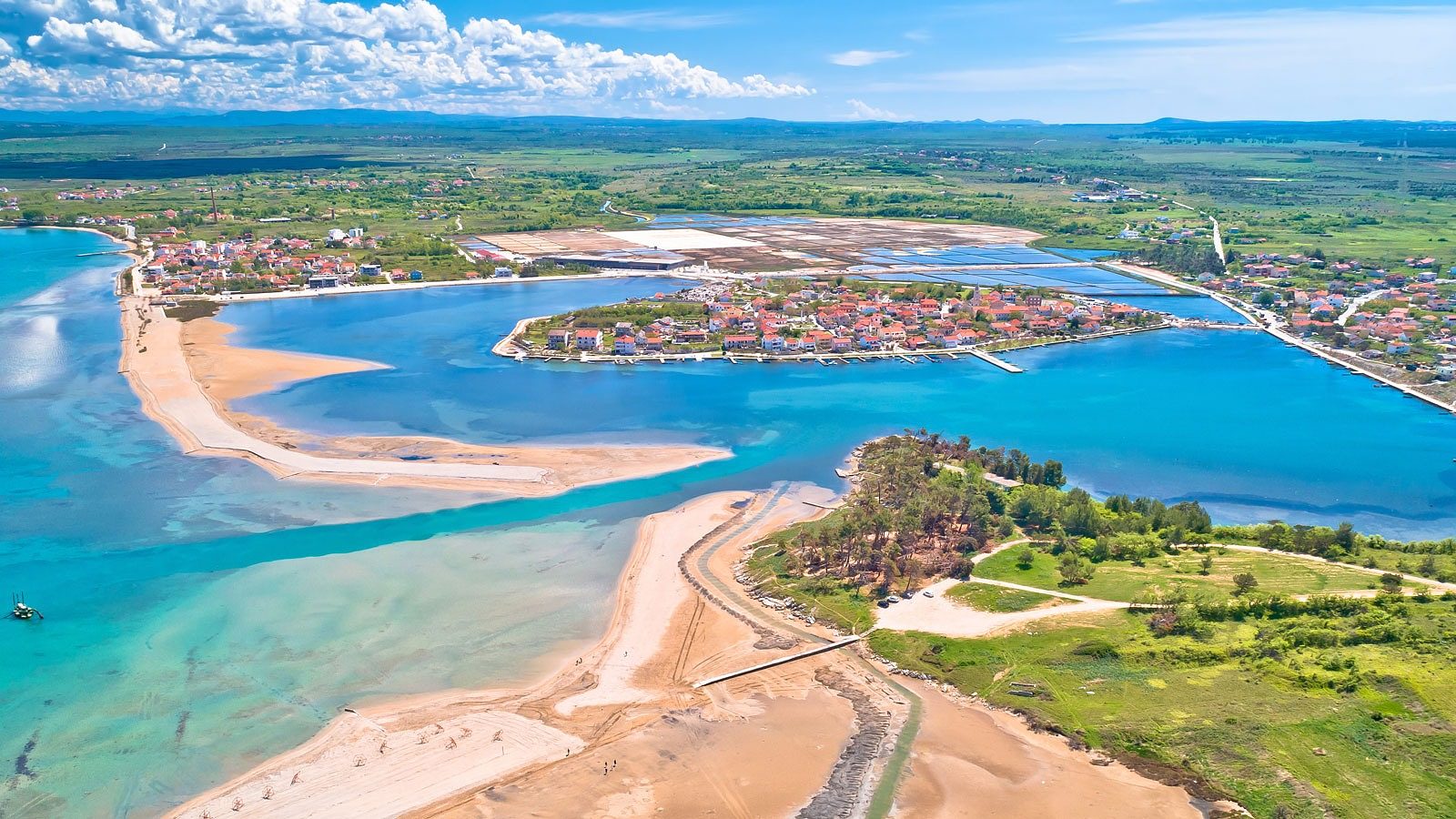
Nin – The Magical City of Kings, Sandy Beaches and Salt
Nin — The Croatian City of Kings with a Cosmic Pedigree
In 1996, two astronomers from the observatory in Višnjan on Istria discovered an asteroid, which they named Aenona – the name of Croatia's oldest royal city, Nin.
As early as the 9th century BC it was a powerful centre of seafaring and trade and an important port on the eastern Adriatic coast, founded by the Illyrian tribe of the Liburnians under the name Aenona.
Nin is otherworldly not only as a celestial body but also because of its historical and natural treasures.

The Symbol of Nin
Even as you approach the town, a gem of architecture appears before your eyes – its symbol and a promise of the wonderful adventure with history that awaits you here at literally every step. On a small rise in the middle of the vast Prahulje plain stands the early-Romanesque Church of St. Nicholas, dating from the turn of the 11th and 12th centuries. It resembles a miniature fortress, and indeed in the 16th–17th centuries, during the Turkish raids, defensive battlements were added and the building served as a lookout post.
The church is 5.9 m long, 5.7 m wide and 6 m high, with walls 50 cm thick. Despite its modest size, it was an important coronation site for Croatian kings. It was here that each of the 7 rulers crowned in Nin presented himself to the nation.
It is said that beneath the surface of the Prahulje rise there are graves that remain unexplored to this day.

The Old Town
Today's Nin old town lies on an island and can only be reached by one of the stone bridges (from the 16th century). The main entrance to the town is guarded by a statue of Duke Branimir. Once you pass through its ancient gates (16th–18th centuries), the magic of the place begins to work and history intertwines with the present.
You drink coffee among fragments of buildings a thousand years old, eat lunch by the walls of a Roman temple, rest on a meadow crisscrossed by the outlines of ancient houses, and stroll where Croatian kings were crowned.
Everyday life unfolds against an ancient, early-Christian and medieval backdrop.
The best example is the remains of a Corinthian column in Višeslav Square, which today's residents use as a pedestal for the statue of the Virgin Mary during the annual procession. The flowers placed on it, once blessed, are said to have miraculous power.

A Town of Churches
Nin is a town of churches, some of which no longer exist, but whose many precious furnishings have been preserved in the ecclesiastical art collection The Gold and Silver of Nin, displayed in the rooms beside the parish church of St. Anselm. Among the most interesting are the ring of Pope Pius II from the 15th century and a piece of Judas' silver, one of only 16 catalogued in Europe.
The parish Church of St. Anselm, called Nin cathedral in the age of the kings, dates from the 6th century. In its chapel stands the figure of the Virgin Mary and Child venerated in Nin (Gospa od Zečeva). Every year on 5 May and 5 August, processions are held to nearby Zečevo, which is an island at high tide and connects to the mainland by a narrow passage at low tide.
Also worth seeing is the restored 13th-century Church of St. Ambrose with Romanesque-Gothic elements, picturesquely set near the Upper Town gate.

The Smallest Cathedral in the World
The undisputed heritage pearl, however, is the pre-Romanesque Church of the Holy Cross, popularly known as the smallest cathedral in the world. It is the most valuable surviving monument of Old Croatian sacral architecture. It was built in the 9th century on the ruins of ancient houses, whose remains are visible around the building. It is the only sacral structure in Nin preserved intact from the moment of its creation to this day.
In the time of the Croatian rulers it served as the chapel of a nearby court, around which many medieval graves have been discovered.
Built on a cross plan and topped with a dome, it is 7.8 m long, 7.6 m wide, 8.2 m high, with walls 57 cm thick.
Thanks to the placement of its oval windows and the angle at which light falls, the church is a kind of calendar and sundial, showing the exact dates of the summer and winter solstices and the equinoxes. Some compare it to Stonehenge.
Since 2009, on the first day of summer, the Festival of Sun and Light is held here.

Roman Ruins
In the pre-Christian era, other gods were worshipped in Nin. In the very centre of the town, on the site of the former Roman forum, lie the remains of a monumental temple, the largest (33 m x 23.5 m) on the eastern Adriatic coast. It is dated to the second half of the 1st century AD, the time of Emperor Vespasian (69–79 AD). On the temple ruins we can see a Corinthian column at its original height of 17 m. In the part of town called Banovac, the remains of a great Roman villa Urbana (17 m x 30 m) were found. Rare floor mosaics from the 2nd century AD with geometric, animal and plant motifs have survived here.
Interestingly, to the north-east of Nin, in the village of Grbe, there is a stone structure that tourists take for a Roman triumphal arch. These are not, however, ancient ruins but the monumental gate to a former tobacco factory, on whose remains today's village grew up.

Meanwhile, numerous artefacts from the prehistoric, Roman, early-Christian and Old Croatian periods can be admired in the Museum of Nin Antiquities (a department of the Archaeological Museum in Zadar).
In seven exhibition halls, objects documenting the most important historical periods of the town's development are presented, along with reconstructions, models, photographs and plans.
The most precious of these are:
- two original Old Croatian ships from the 11th century, the Condura Croatica
- a replica of part of the Serilia Liburnica ship from the 1st century
- a copy of the baptismal font of Duke Višeslav (the first Croatian duke, who ruled around 800 AD) – a perfect example of church furnishings from the era of the Christianisation of the Croats. (The original is kept in the Museum of Croatian Archaeological Monuments in Split.)
The Condura Croatica
The history and story of Nin, the development of the town, are inseparably linked with a long seafaring tradition. It is confirmed by the remains of the Condura ships discovered at the entrance to Nin harbour in 1966. After being raised in 1974, the vessels were taken to Zadar, where their desalination, conservation and restoration began.
The remains of the ancient harbour itself (1st century BC) lie in the sea in today's village of Zaton, off Cape Kremenjača, and are still the subject of underwater archaeological research.
The ships that were found sailed the seas at the end of the 11th and the beginning of the 12th century. It is most likely these that Emperor Constantine Porphyrogenitus refers to when he mentions the Old Croatian navy numbering 80 vessels. For this reason they were given the name Condura Croatica.
It is interesting that these ships were the smallest and deadliest warships in the history of the world. They were 7–8 m long, narrow and built by the classic rib method, with the hull planking joined by wooden and iron nails. They carried a sail. They were used as fast oared ships.
Historical records state that in the time of King Krešimir IV, Croatia had as many as 20,000 oarsmen on the conduras, and King Tomislav had 15,000 oarsmen at his disposal in Nin alone.
The town currently has 2,700 inhabitants (2011 census), so one can imagine what a great metropolis it was in the Middle Ages.
The recovered Condura Croatica is today housed in a special pavilion of the museum in Nin, and its replica can be seen in the sea beside the Lower Town Bridge.

Salt More Precious Than Gold
The wealth and prosperity of the Nin region had their source in salt production, which in prehistoric and ancient times was worth its weight in gold. The old method of production has been preserved to this day, and its secrets can be discovered in the Salt Museum. The Nin salt pans make use of the natural strengths of this area: many sunny days, winds and a favourable geographic location. In shallow evaporation basins separated by embankments, seawater evaporates, leaving on the bottom a salt rich in minerals and high in iodine (thanks to algae). It is harvested only by hand. This is why Nin salt is one of the highest quality in the world. Its most precious form is the so-called flower of salt – delicate, healthy and highly prized. It forms only under specific conditions, when a very thin layer of crystals resembling snowflakes appears on the surface of the water. This salt caviar makes up only a small part of production and commands a considerably higher price.
This extraordinary delicacy, together with other souvenirs such as various kinds of table and bath salts, chocolates and biscuits with salt, can be bought at the Salt Museum.

A Unique Ecosystem
The salt pans also form a unique ecosystem. The extraordinary natural conditions – characterised by the type of substrate, salinity, artificial basins, a shallow lagoon and the specific plants that grow here – have created an extreme environment, yet one rich in many animal species adapted to life in these areas.
Wetlands (and the salt pans are an example of an artificial wetland) are important for the protection of rare and endangered species, especially birds. In Nin, more than 250 species can be observed, including herons and cormorants. It is the habitat of the endemic Vlastelica (a bird with black wings and back and a white belly and neck, which in summer swims across the salt pans with its young).
Besides the man-made evaporation basins, very rare habitats have naturally formed in the Nin lagoon and are protected – fertile muddy or sandy shores with wetland and marshy areas, and sandy dunes with very sparse vegetation.

The Nin Riviera – the Largest Stretch of Sandy Beaches in Croatia
The sandy coastline around Nin runs uninterrupted for a full 8 km and is especially prized by families with small children and by surfing enthusiasts.
The largest and best known is Kraljičina plaža (Queen's Beach), which took its name from the wife of the first Croatian king, Tomislav. She was enchanted by this place and spent time here with her family at every opportunity. The huge shallow bay, with sand underwater and warm water, is a safe place for the youngest to play and swim. The beach is well equipped, with shade parasols, deckchairs for hire, toilets, changing rooms and catering facilities.
It ranks highly on the American Travel Channel's list of the most beautiful beaches in the world.
Other attractive Nin beaches include Ždrijac, Prodorica, Bilotinjak and the Zaton Holiday Resort.

The beach of the Zaton tourist resort, awarded the Blue Flag for quality, offers a whole range of attractions for children and adults – a water park, pools, diving, SUP paddleboarding, parasailing behind a motorboat and more. Admission for visitors who are not resort guests is charged.

A Paradise for Surfers and Lovers of Active Recreation
The winds of the Nin lagoon provide ideal conditions for surfing, and windless days are a rarity here. Lovers of windsurfing or kitesurfing will be delighted by the picturesque setting for these sports, suspended between the historic old town and rocky Pag, with a view of the slopes of the Velebit massif. On the local beaches there are equipment rentals and training centres where anyone can begin their sporting adventure under the eye of an instructor.

In the area around Nin there are as many as 110 km of marked cycling routes. It is a great way to move actively between the natural and historical attractions.

The beaches and surrounding areas can also be admired from horseback. For those interested, there are options for recreational trail riding, horse-riding lessons and pony rides for children.

At the Holiday Village Zaton tourist resort you will find a rich sports and recreation offer – tennis courts, a volleyball court, bowling, table tennis and mini-golf.
Healing Mud – Where Nature Cures
Peloid is healing mud discovered in the areas near Kraljičina plaža. For over 40 years it has been used to treat various ailments such as rheumatism, spinal deformities, musculoskeletal problems, female fertility issues and skin diseases.
Treatments should be carried out under supervision and at the frequency recommended by a doctor. They usually last 10–20 days and involve coating with mud, then sunbathing on the beach and washing off the dried layer of peloid in the warm sea. These unusual „treatments” are carried out in July and August in the morning.
Nin mud was, however, already used in Roman times. It is believed that in the distant past there must have been thermal baths in these areas. This is attested by tegulae found here – round bricks used to heat the air in such buildings.
In the future there are plans to build a rehabilitation and treatment complex using the peloid.

Mediterranean Cuisine
After a day full of impressions, it is worth having a meal in one of Nin's restaurants serving local Mediterranean delicacies. Some of these establishments, besides culinary attractions, also offer aesthetic ones. For example, Konoba Stara Kužina has a beautiful garden and is located right by the Roman temple. As a starter, it is worth ordering šokol – a unique Nin delicacy.
The Nin Šokolijada
Šokol can be tasted in many eating establishments, but if you happen to be in the area in July it is worth taking part in the Šokolijada held every year – a competition that attracts the greatest masters of this culinary field.
At the beginning of the year, the meat needed to prepare this delicacy is divided among the participants. For 6–7 months they prepare the finest-quality pork according to their own recipes. First the meat is left for a few days in sea salt, then soaked in boiled red wine, various spices are added, and it is then smoked and dried in the bura wind. The competitors, however, never reveal the entire recipe for preparing the best cured meat. The recipe is passed down within the family only by word of mouth. That is why winning the Nin šokolijada is a matter of prestige.

The First Croatian Gin and Exclusive Spirits
Experience and passion have also led to the creation of other delicacies for which the Nin area is renowned. In nearby Zaton there is the Mashtel distillery. It is the work of two friends and, although small, it has managed to gain international acclaim. The owners learned how to produce the best rakija in Serbia, in the finest distilleries and under well-known specialists in the field. In the end they founded their own business and invested in the most advanced distillation machine from Arnold Holstein.
Focusing on the highest quality and continually refining their recipes, they have created a range of products that today appear on the menus of several Michelin-starred restaurants, grace the tables of the Office of the President of Croatia, and are ordered as luxury gifts by companies and private individuals at home and abroad.
According to their own recipes, they prepare 8 kinds of rakija (e.g. tangerine, melon), 4 liqueurs (breadfruit, maraska cherry, apple, fig) and Gin Puro – the first Croatian gin (grappa-based).
The rakijas are made from the family's own wines from Ilok. The flavour is obtained by a special method of soaking the fruit in alcohol.
At its premises in Zaton, Mashtel offers tastings of its own spirits (price around 50 EUR) with an appetiser of local products.

Kraljevski Vinogradi – a Vineyard with a Sea View
In the area around Nin, on the hills above the village of Petrčane, there is an exceptional vineyard with a beautiful view of the sea and the surrounding islands. The name Kraljevski Vinogradi (Royal Vineyards) suggests that the wines here are worthy of a king himself. And indeed, the excellent quality of the grapes and the fine taste of the wine are the result of the specific microclimate and natural conditions of this place. The vines grow on stony ground on a coastal slope with a south-westerly exposure. All-day direct sunshine and the constant circulation of sea and mountain air (from Velebit) create rather extreme yet at the same time favourable conditions for cultivation.
In the local konoba you can eat well and taste wines such as Plavac mali, Muškat, Rose Scuro, Crljenak (an old 15th-century Croatian variety) and Pošip (the tradition of cultivating this local Dalmatian white variety dates back to ancient Greek times).

See You Again Soon
To conclude, let us return to the town of Nin itself. Enchanted by the town's long history and former glory, richer for so many new experiences, indulged by the gentleness of the beaches and the warmth of the sea, you will surely long to visit Nin again. Not sure whether you'll manage it? Seek out the monument to Bishop Grgur Ninski, sculpted by Ivan Meštrović.
Grgur Ninski is the most famous of the local bishops, who was a kind of ambassador and great promoter of the Glagolitic script and the Old Croatian language. The oldest Croatian books – written monuments proving the existence of an ancient culture and national identity in these lands – were recorded in Glagolitic. Examples of Glagolitic inscriptions (from the 20th century) can be seen on the monument to Duke Branimir and on the well cover in front of the Church of St. Anselm.
And what does the Grgur monument have to do with our wish to find ourselves in Nin again one day? Well, the locals believe that touching his big toe guarantees the fulfilment of any wish...
... so, until we meet again!

CROWONDER Properties Located in Nin and the Surrounding Area
We invite you to our properties, located within a few kilometres of the old town of Nin. Spending your holidays in them, you will be able to reach all the attractions of this exceptional region conveniently and quickly.
NIN – Villa with pool Crowonder Amazing Time located near Ždrijac beach.

NINSKI STANOVI – House with pool Crowonder Nin Beauty, about 4 km from Nin.

PRIVLAKA – a complex of four neighbouring Nina villas, each with a private heated pool, about 5 km from Nin. The available properties are Crowonder Villa Nina 1, Crowonder Villa Nina 3, Crowonder Villa Nina 4 and Crowonder Villa Nina 5.

PRIVLAKA – Crowonder Villa Countes with pool, about 5 km from Nin.

Take a look also at our other high-standard properties in the village of Privlaka, located 7–9 km from the town of Nin.
VRSI MULO – Crowonder Vrsi Twin Villas with private pools, located about 6 km from Nin. Two twin properties are available with the option of ordering meals – villa V1 and villa V2.

We also encourage you to explore the properties we have prepared for our guests in the village of Petrčane, about 8 km from Nin.
See you on the beaches of the Nin lagoon!