

PAG - See It, Feel It, Experience It
Pag — An Island You Will Never Forget
They say you either love Pag or hate it, though personally I have never met anyone who was disappointed by the island. One thing is certain: this extraordinary place leaves no one indifferent.
Those who were not captivated by the island probably experienced their stay only superficially and did not give themselves time to soak up its aura and mysticism. Pag must be discovered with all your senses.
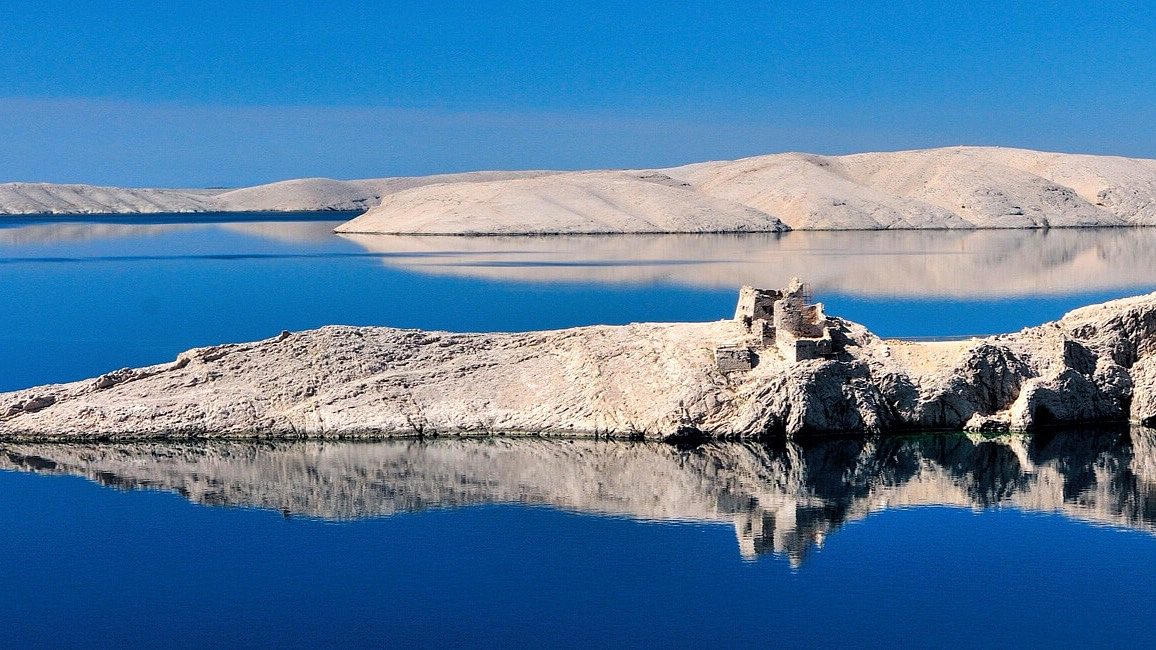
Its raw nature, full of contrasts, radiates an unreal beauty. The sea, in every shade of blue and turquoise, stands out sharply against the sandy-white rocks, as if in a painting.
The desert-like, rocky landscape, covered mostly with herbs and clumps of Mediterranean maquis, brings to mind another planet or the moon — to which we are transported by a three-hundred-metre bridge suspended 27 metres above the waters of the Adriatic. Sometimes the bura wind forbids entry to this “other” world, as if it wanted to hide the island from curious eyes. Today it was kind.

Photo: Paški Bridge and the Velebit mountains — view from the Fortica fortress.
Salt Pans, Nature Reserves and the Kingdom of Sheep
If, as you drove onto Pag, you thought it would be monotonous — the island will surprise you sooner than you think. Among the bare, rocky hills hide the salt pans — basins for evaporating salt from seawater — and the occasional oasis of greenery, as if pasted in from a different story. The most surprising of these is the Veliko Blato ornithological reserve, where a freshwater lake and reed-covered marshes stretch across 462 hectares. The area teems with life. For many migratory birds this place is the last stop before the crossing south, over the sea. Leading to the reserve is — as is typical on Pag — a narrow local road running between endless stone walls. Sooner or later your way will be blocked by a flock of sheep ambling unhurriedly in some unknown direction — this is their kingdom, and you must wait. You can linger for a while, surrounded on all sides by bleating balls of wool — use that time well: on the horizon the slopes of the majestic Velebit mountains glisten in the sun, and you could gaze at them for hours.

Photo: Veliko Blato ornithological reserve.
Such attractions are not reserved for drivers alone. The boundless plains, hills and valleys of Pag are a paradise for lovers of trekking and cycling, no matter the time of day or night. You can plan such a trip yourself or join a guided expedition organised by a local agency. Whatever you choose, prepare well for the route and do not forget to bring your camera — you never know what wonders you might capture. On Pag, the unearthly can take on a very real form.

Photo: The island of Pag seen from the Velebit Channel.
UFOs and the Mysterious Paški Triangle
The island is well known among researchers and UFO enthusiasts. Unidentified flying objects have been observed here many times by crowds of people. Some sightings have been documented in photographs and recordings, and even in an official police report. Experts on the subject claim that these unexplained phenomena may be connected with the mysterious Paški Triangle, discovered in 1999 on the Velo tusto čelo hill near Novalja. It is an imprint on the rocks measuring 32m×32m×22m, within which the stones have a lighter shade and — as geological studies have confirmed — glow red under ultraviolet light. Such properties are said to characterise places subjected to enormous temperatures, and this one on Pag may have formed twelve thousand years ago.

Photo: Signpost to the Paški Triangle.
This is not the island's only unexplained mystery — intriguing facts and fascinating stories touch practically every corner of it.
The Sunken City of Cissa and Ancient Traces
The bay at the village of Caska conceals the submerged remains of an ancient city, about which, despite numerous archaeological studies, little is known. Nor has it been explained why the metropolis ended up underwater.
Legend says that its arrogant, wealthy and dissolute inhabitants were struck by divine punishment, much like biblical Sodom and Gomorrah. Ancient Cissa, however, was most likely destroyed by an earthquake in the year 361, or by a catastrophic collapse of sedimentary rock — breccia — that resulted from the erosion and washing away of the supporting flysch, 2-3m high. The buildings tumbled into the sea, and their remains are still being discovered and studied today. It is not known how large this archaeological site is, nor what secrets await beneath the water. So far, discoveries have included an underground tunnel (2.5m high, 1m wide) of unknown purpose, most likely part of a larger complex, a magnificently preserved Roman anchor, and a ship built using a method employed by the Illyrians — bound with ropes made of Spanish broom or flax.
Tiny, peaceful Caska was most likely a dynamically prosperous metropolis that met a tragic end.
Today, life pulses in the nearby resort of Novalja and the Zrće beach adjoining Caska.
This town, which grew from a fishing settlement into a tourist gem, has a rich and turbulent past, attested to by numerous archaeological finds. It is here that you will find a Roman underground aqueduct, carved into the rock in the 1st century, which supplied water from the Novalja plain 1.2km away. The structure is about 60m wide and has 9 openings leading to the surface — at these points it reaches a height of 40m. It was most likely part of a larger network supplying water for the inhabitants as well as for local craft workshops, the port and ships. The aqueduct is a find unique on a Croatian scale and one of the few ancient structures to survive to our times practically intact.

Photo: Novalja — a modern tourist complex by the beach.
Novalja and Zrće — the Croatian Ibiza
Over the last decade or so, Novalja has grown from a typical family-holiday town full of private rooms into a resort offering luxurious accommodation in modern hotels and villas, long beautiful beaches, a strong culinary scene, numerous attractions and plenty of wild fun.
Administratively part of the town and located about 1.5km from its centre, Zrće beach is currently the leading party destination in Croatia and one of the largest in Europe. In season the fun here never ends, and the Croatian Ibiza hosts famous DJs and numerous music festivals. This picturesque beach, home to several clubs, draws fans of electronic music and nightlife from all over the world.

Photo: Zrće beach.
The Beaches of Pag — from Family-Friendly to Wild
For those who prefer to rest in peace and quiet, the island of Pag is once again a great choice for a holiday. The wide variety of beaches of different kinds means everyone will find their dream spot, suited to their personal needs or momentary mood. Some are easily reached on foot or by car, others require a longer walk or are accessible only by boat. Whether the bura or the jugo wind is blowing, you can always find the perfect place for the weather.
The main towns (e.g. Novalja, Pag, Šimuni, Povljana) most often offer well-developed, long and wide gravel/fine-pebble beaches with a gentle shoreline, and even sandy bottoms, which are ideal for families with small children.
Those who prefer to escape the crowds and hide away in their own piece of paradise have many wild beaches and coves at their disposal, enchanting in their beauty. When choosing one, it is worth checking whether the route and location will suit you (especially for children) and whether you are prepared to spend the day “beyond civilisation”. Rocky approaches and coastlines can be dangerous, and a lack of shade, high temperatures and insufficient drinking water supplies can turn an idyllic rest into a nightmare. Sometimes beauty gives a false sense of security.

Photo: Jadra beach.
It is impossible to describe all the picturesque corners, but a flagship example is Beritnica. This view (photo below) is surely one of the symbols of Pag. A wonderful wild beach, with three characteristic rock formations, takes your breath away. Nearby stands the well-known rock face — Stogaj — with climbing routes suited to both beginners and experienced climbers.

Photo: Beritnica beach.
The Town of Pag — History, Lace and Culture
After a day spent on the beach, it is worth doing some sightseeing, and the very essence of the island's rich and fascinating history can be found in Pag. It is best to first take in the town from the viewpoint located by the main road to Novalja, from where its intriguing setting is beautifully displayed.
Strolling along the waterfront and the narrow stone lanes, everyone can find something for themselves — historic sites, sacred buildings, the ducal palace, remains of fortifications, historic salt warehouses, ethnological exhibitions, or the gallery of Pag lace, which in 2009 was inscribed on the UNESCO list of intangible cultural heritage. Lovers of antiquity will surely be interested in the Stari Grad archaeological site with the remains of an acropolis, a kilometre from the town centre.
In summer, Pag hosts numerous cultural events (among them the Pag Art Festival), exhibitions, theatre performances, concerts and events promoting local folklore, during which original folk costumes, dances, songs and brass music are presented.
In the evening, you simply must go for dinner at one of the atmospheric restaurants. The culinary offer is wide, but it is worth focusing on traditional dishes and tasting local products. On the menu: Pag lamb, fresh fish, seafood and a variety of appetisers, among which cheese reigns supreme.

Photo: The town of Pag from a bird's-eye view.
The Flavours of Pag — Cheese, Honey, Salt and Wine
Paški sir (Pag cheese), produced from sheep's milk, owes its inimitable flavour to the specific natural conditions in which the animals are raised. The sheep feed on sparse Mediterranean vegetation and aromatic plants on which settles the salt carried from the sea by the winds. This local delicacy, made according to a traditional recipe on small family farms and at several larger dairies, is known worldwide and has won many awards, including the title of best cheese in Central and Eastern Europe. Pag cheese can be bought all over the island, with the most tasting and sales points in the village of Kolan and the town of Pag.
Other well-known local products are sage honey, Pag salt and baškotin — a hard, sweet rusk baked according to a three-hundred-year-old recipe that is a secret of the Benedictine convent.
Pag also produces wines, and to all lovers of this drink we recommend a visit to the Boškinac winery and restaurant (near Stara Novalja). It is a charming place with a unique atmosphere, where you can savour the flavours of Pag to your heart's content.
While in the northern part of the island, it is worth visiting Lun, where around 80,000 olive trees grow across 23 hectares, forming a natural reserve. Some of the trees are hundreds of years old and have grown to considerable size. Such beautiful and enormous olive groves are found in only two other countries in the world — Israel and Greece.

Photo: Sheep on the island of Pag.
Active Recreation — Via Ferrata and Life on Mars
The island of Pag is a mecca for lovers of spending free time outdoors. Kilometres of hiking and cycling trails, climbing spots, quad safari, paintball, diving, cruises... — many interesting options, along with excellently described and documented routes, can be found at www.pag-outdoor.com.
One of the most famous and award-winning attractions is the Life on Mars trail, with its incredible sea section, the Via Ferrata — a hundred-metre-long rock passage suspended 1-2 metres above the water.

Photo: Via Ferrata.
Pag Summer Outdoor and the Granfondo
Every year from June to September the island hosts Pag Summer Outdoor, whose programme features numerous options for the active, including trekking, trail running, climbing, hiking and cycling expeditions, kayaking trips and SUP.

Photo: A kayaking trip.
The chance to test your strength in such stunning natural scenery draws not only amateurs but also professionals, for whom numerous sporting events are organised.
On 15 October 2022 the Third International Cycling Marathon Granfondo Pag — Cycling on the Moon took place.
The main race covered the Novalja-Metajna-Žigljen-Stara Novalja-Lun-Novalja route, 85km long with an elevation gain of 1200m.
Participants in the recreational Mini Granfondo, meanwhile, had 35km to cover with an elevation gain of 600m between the towns of Novalja-Metajna-Žigljen-Novalja.

Photo: The island of Pag — the Fortica fortress.
A Piece of Your Heart Will Stay on Pag
However long I might talk about Pag, this sunny island would still have something new to offer. No description or review can convey the beauty, the mood and the atmosphere that await you on the spot. If you thought I had already revealed everything to you, I can tell you this is only the beginning of your adventure. You have to see it, feel it and experience it in person... if you dare to take the risk — because you will surely leave a piece of your heart on Pag forever.
Where to stay?
Our travel agency CROWONDER has two apartments on Pag with a beautiful view of the Pag bay, and soon our offer will include new properties located in other corners of this magical island as well.
The Crowonder Pag View A1 and Crowonder Pag View A2 apartments are two comfortable units, each with two bedrooms, located in the same building, 180m from the beach. Large terraces overlooking the most beautiful combination of sea, rocks, Velebit and sky will become your favourite spot for a morning coffee or an evening drink.

Photo: Crowonder Pag View apartments.